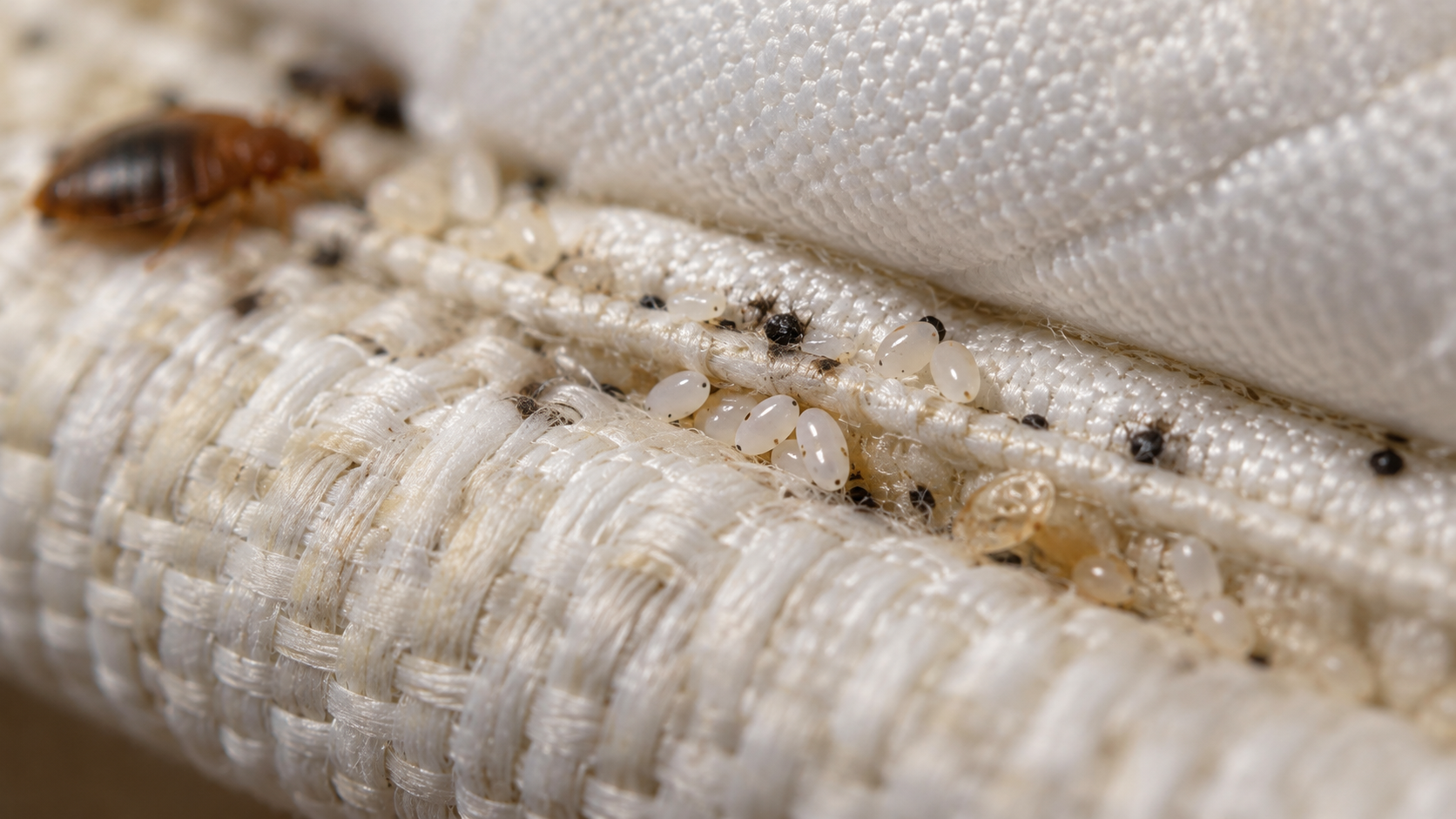
What Do Bed Bug Eggs Look Like?
Bed bug eggs are extremely small, which is one reason early infestations can be difficult to notice.
A typical bed bug egg is approximately 1 millimeter long, roughly comparable to the size of a tiny grain of salt or the head of a small pin. The eggs are generally white, off-white, or pearl-colored and may appear slightly translucent under bright light.
Unlike crumbs, lint, or loose debris, bed bug eggs are often glued directly to the surface where they are laid.
The U.S. Environmental Protection Agency describes bed bug eggs as tiny, white eggs that are attached to surfaces. Bed bugs typically place their eggs in protected locations close to their hiding areas.
What Color Are Bed Bug Eggs?
Bed bug eggs are usually:
- White
- Creamy white
- Pearl white
- Slightly translucent
Freshly laid eggs may appear somewhat shiny. As the egg develops, you may sometimes notice a darker spot inside, although this can be difficult to see without magnification.
Bed bug eggs generally do not look brown, black, or reddish.
If you are seeing dark spots around a mattress seam, those may be bed bug fecal stains rather than eggs.
How Big Are Bed Bug Eggs?
Bed bug eggs are usually around 1 millimeter long.
Because they are so small, they can easily be mistaken for:
- Dust
- Salt grains
- Skin flakes
- Fabric fibers
- Dandruff
- Tiny food crumbs
- Other insect eggs
A flashlight and magnifying glass can make inspection much easier.
Bed Bug Egg Size Comparison
| Object | Approximate Size |
|---|---|
| Bed bug egg | About 1 mm |
| Grain of table salt | Around 0.3–0.5 mm |
| Adult bed bug | About 5–7 mm |
| Apple seed | About 6–8 mm |
Adult bed bugs are much easier to see than their eggs. The eggs may be visible to the naked eye, but identifying them correctly can still be difficult.
What Shape Are Bed Bug Eggs?
Bed bug eggs are generally:
- Oval
- Elongated
- Slightly rounded
- Smooth
- Narrower at one end
They can sometimes resemble a miniature grain of rice, although they are far smaller than actual rice.
One end of the egg has a small cap-like structure through which the young bed bug eventually emerges.
Are Bed Bug Eggs Sticky?
Yes.
Female bed bugs produce a sticky substance that helps attach their eggs to surfaces.
That means bed bug eggs may remain firmly attached to:
- Mattress fabric
- Wood
- Furniture joints
- Baseboards
- Bed frames
- Upholstery
- Cracks and crevices
If a white particle brushes away immediately, it may simply be dust or debris.
However, attachment alone does not prove that something is a bed bug egg.
Where Do Bed Bugs Lay Their Eggs?
Bed bugs usually lay eggs in sheltered locations close to areas where people sleep or remain still for long periods.
Common locations include:
Mattress Seams
Inspect:
- Seams
- Tufts
- Piping
- Labels
- Folds
Pay particular attention to the underside of the mattress and areas near the head of the bed.
Box Springs
Bed bugs often hide inside or underneath box springs.
Look around:
- Fabric edges
- Staple lines
- Wooden framing
- Corner protectors
- Torn fabric
Bed Frames
Inspect joints and connection points carefully.
Bed bugs may lay eggs:
- Behind screws
- Inside bolt holes
- Between pieces of wood
- In cracks
- Around brackets
Headboards
Headboards are one of the most common hiding locations because they are close to a sleeping person.
Check:
- Behind the headboard
- Screw holes
- Decorative grooves
- Upholstery seams
- Areas where the headboard touches the wall
Furniture Near the Bed
Bed bugs may also hide in:
- Nightstands
- Dressers
- Upholstered chairs
- Sofas
- Recliners
- Bedside tables
Inspect joints, seams, drawers, and undersides.
Baseboards and Wall Cracks
As infestations grow, bed bugs may spread beyond the bed.
Look around:
- Baseboards
- Wall cracks
- Electrical outlets
- Wallpaper edges
- Flooring gaps
- Trim
What Do Bed Bug Eggs Look Like on a Mattress?
On a mattress, bed bug eggs may look like tiny white dots stuck along a seam or fold.
They may appear individually or in small groups.
A heavily infested mattress may also show other signs nearby, including:
- Live bed bugs
- Shed skins
- Dark fecal spots
- Rust-colored stains
- Small blood stains
- Nymphs
Finding multiple signs together makes a bed bug infestation much more likely than finding a single unidentified white speck.
Do Bed Bug Eggs Look Like Rice?
People frequently describe bed bug eggs as looking like tiny grains of rice.
That comparison can be useful for understanding the shape, but it can also be misleading.
A bed bug egg is dramatically smaller than a normal grain of rice.
Think of it as a microscopic-looking miniature grain of rice, approximately 1 millimeter long.
Do Bed Bug Eggs Look Like Salt?
Bed bug eggs can sometimes be confused with salt because they are small and light-colored.
However, there are differences.
Salt crystals typically:
- Have angular or crystalline shapes
- Move easily
- Scatter when touched
Bed bug eggs usually:
- Have a smooth oval shape
- Are attached to a surface
- Appear slightly translucent or pearl-like
Bed Bug Eggs vs Dandruff
Dandruff commonly falls onto mattresses, pillows, and upholstered furniture and can sometimes be mistaken for bed bug eggs.
Dandruff
Usually:
- Flat
- Irregularly shaped
- Flaky
- Easily moved
Bed Bug Eggs
Usually:
- Oval
- Smooth
- Three-dimensional
- Attached to a surface
Bed Bug Eggs vs Flea Eggs
Flea eggs can also be white and small.
One major difference is how they behave.
Flea eggs are generally not firmly glued to surfaces. They can fall off animals and accumulate in carpets, pet bedding, and floor cracks.
Bed bug eggs are typically attached to the surface where the female lays them.
Bed Bug Eggs vs Carpet Beetle Eggs
Carpet beetle eggs may also be small and pale.
However, carpet beetles are commonly associated with:
- Wool
- Natural fibers
- Stored fabrics
- Animal hair
- Feathers
- Carpeting
Bed bugs are more strongly associated with sleeping and resting areas because they feed on blood.
If you are finding pale objects near a bed, inspect the surrounding area for additional signs before deciding which pest is present.
How Many Eggs Can a Bed Bug Lay?
Female bed bugs can lay several eggs per day under favorable conditions.
The CDC notes that female bed bugs may lay roughly five eggs per day in sheltered locations.
Over time, this can allow an infestation to grow considerably if it remains unnoticed.
How Long Do Bed Bug Eggs Take to Hatch?
Bed bug eggs commonly hatch within approximately 4 to 12 days, depending on environmental conditions.
After hatching, the young bed bug is called a nymph.
Nymphs resemble smaller and lighter-colored versions of adult bed bugs and must feed on blood before progressing through their developmental stages.
What Do Hatched Bed Bug Eggs Look Like?
After a bed bug emerges, the empty eggshell may remain attached to the surface.
Hatched eggs may look:
- Hollow
- Clearer than intact eggs
- Open at one end
- Flattened or partially collapsed
Finding empty eggshells can indicate previous or ongoing bed bug activity.
Can You See Bed Bug Eggs With the Naked Eye?
Yes, but they can be difficult to identify.
At approximately 1 millimeter long, bed bug eggs are technically visible without magnification.
However, because they are so small and pale, they are easy to overlook.
For inspection, use:
- A bright flashlight
- A magnifying glass
- A thin inspection tool or old credit card for seams
- A clear plastic bag or tape for collecting samples
Does Finding Bed Bug Eggs Mean You Have an Infestation?
Finding something that appears to be a bed bug egg should be taken seriously, but identification should be confirmed whenever possible.
Look for additional signs such as:
- Live adult bed bugs
- Bed bug nymphs
- Black fecal spots
- Shed skins
- Blood stains
- Clusters of eggs
A single white speck does not automatically mean you have bed bugs.
Many harmless household materials can resemble bed bug eggs.
What Should You Do If You Find Bed Bug Eggs?
If you believe you have found bed bug eggs, avoid immediately spraying random pesticides or throwing away furniture.
Instead:
- Photograph the suspected eggs.
- Collect a sample if possible.
- Inspect nearby mattress seams, furniture, and bed frames.
- Check for additional signs of bed bugs.
- Reduce clutter around sleeping areas.
- Avoid moving potentially infested furniture into other rooms.
- Consider contacting a licensed pest management professional.
The EPA recommends confirming the pest whenever possible before beginning treatment.
Can You Kill Bed Bug Eggs?
Bed bug eggs can be more difficult to eliminate than exposed adult bed bugs because they are small, protected, and often hidden deep inside cracks.
Professional bed bug treatment may involve several methods, including:
- Heat
- Steam
- Vacuuming
- Mattress encasements
- Targeted insecticides
- Crack and crevice treatment
- Monitoring devices
- Follow-up inspections
Bed bug control usually works best as part of an integrated pest management strategy rather than relying on a single pesticide application.
Do Bed Bug Eggs Mean the Infestation Is Getting Worse?
Eggs indicate that bed bugs have been reproducing.
That does not necessarily reveal the size of the infestation, but it does mean prompt inspection is important.
Bed bugs can remain hidden in extremely small cracks, and early infestations are generally easier to manage than large, established ones.
Check the Entire Sleeping Area
If you find possible bed bug eggs, do not inspect only the mattress.
Check approximately several feet around the sleeping or resting area, including:
- Mattress
- Box spring
- Bed frame
- Headboard
- Nightstands
- Upholstered furniture
- Baseboards
- Wall cracks
- Flooring edges
- Electrical outlet areas
- Luggage stored near the bed
The goal is to identify multiple pieces of evidence rather than relying on one suspicious object.
The Bottom Line
Bed bug eggs are tiny, white or pearl-colored, oval eggs that are usually attached firmly to surfaces.
They are most commonly found in protected areas such as mattress seams, box springs, headboards, furniture joints, and cracks near sleeping areas.
Because bed bug eggs are only about 1 millimeter long, they are easy to confuse with household debris and the eggs of other insects.
If you find suspected bed bug eggs, look for additional signs such as live bed bugs, dark fecal spotting, shed skins, or recently hatched nymphs.
When identification is uncertain, collecting a sample or contacting a pest management professional can help you confirm what you are dealing with before treatment begins.
Related reading
- Bed bug identification center: signs, look-alikes and where to check
- Bed bug droppings: what they look like and what they mean
- Professional bed bug inspection: when to have suspected eggs confirmed